The Real Barrier to Open Badge Adoption Isn’t Belief. It’s Cost
The Real Barrier to Open Badge Adoption Isn’t Belief. It’s Cost
May 6, 2026 - by Paul Baxter
Open badges can transform recognition, progression and workforce development, but cost, complexity and poor implementation models have slowed adoption.
Open badges solved a real problem
Open badges are one of the best ideas in education and workforce development. They are open, interoperable, standardised, and designed to recognise a much wider range of achievement than traditional qualifications ever could. They make learning visible.
They capture skills, behaviours, progression and participation. They are flexible, portable, and built to work across organisations and systems.
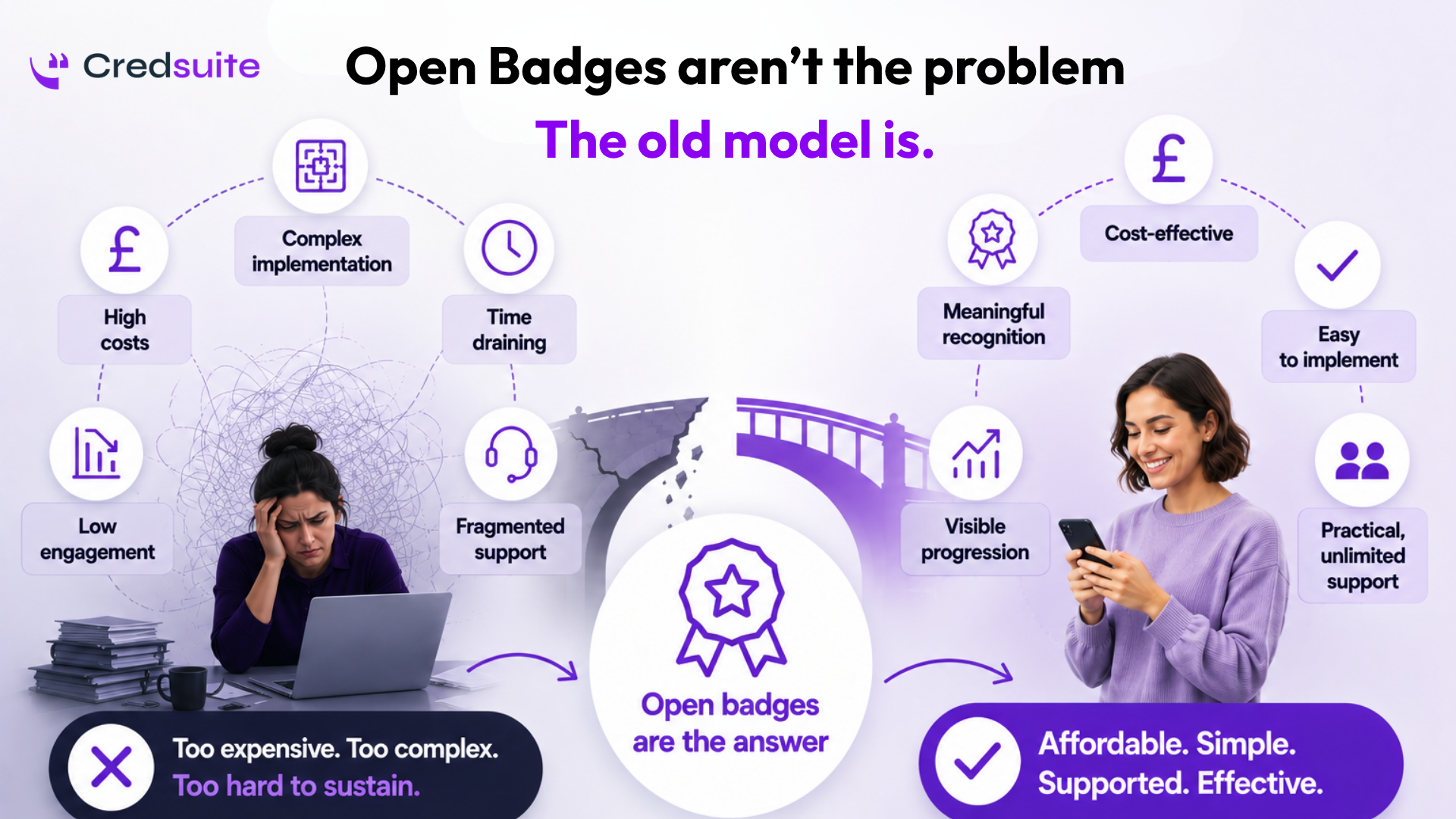
In short, open badges are not the problem. Open badges are the answer.
So why hasn’t the sector fully adopted them?
The honest answer is cost. Not just the cost of the technology itself, but the total cost of trying to make it work.
Organisations have spent years paying for platforms that charge per seat, per feature, or even per badge issued. They’ve invested in functionality they don’t use, don’t need, or could access elsewhere for a fraction of the price. And then, on top of that, they’ve poured internal time and resource into making those platforms work. T
Teams have been pulled into planning meetings, strategy sessions, training programmes and implementation cycles. Roles have been created just to manage digital badges. Internal frameworks, QA processes and guidance documents have been built from scratch. Badges have been meticulously written and designed.
And after all of that effort, many organisations end up issuing badges with claim rates of 2% or 5%.
When the economics stop making sense
At the same time, many have been pushed towards expensive, platform-centric support models or external consultancy, adding another layer of cost without necessarily improving outcomes.
This is where the model starts to break.
When issuing a single badge can cost several pounds, and the surrounding effort is this high, the economics stop making sense. The promise of open, accessible recognition gets replaced by something expensive, complex and difficult to sustain. It’s not that organisations don’t see the value in badges, it’s that the route to delivering them has become too heavy.
The frustration is that the potential is huge
And that’s the frustration. Because the potential of digital credentials is huge. They can transform how organisations recognise learning, skills and progression. They can make achievement more meaningful and more visible. But only if they are actually used.

Why we built Credsuite
Not because we don’t believe in open badges, but because we believe in them so strongly that the current model wasn’t good enough.
Credsuite brings together the most cost-effective issuing platform on the market with the only model that puts practical, unlimited support at the centre. It combines OBF Pro for issuing and reporting, Credwriter for designing high-quality credentials, My Skills Pass for showcasing achievements, and specialist support to help organisations actually implement and use badges effectively. It’s designed so organisations don’t just buy a platform — they build something that works.
A different approach to badge adoption
The difference is in the economics and the approach. Instead of charging pounds per badge, the cost can be a fraction of that. Instead of charging extra for onboarding, training or strategic support, it’s built in. Instead of assuming organisations will figure it out alone, it provides ongoing, practical help to make sure badges are created, issued and used in a meaningful way.
The Barrier was never belief
The real barrier to open badge adoption has never been belief. It’s been cost, complexity and lack of support.
If we want open badges to deliver on their promise, we need to remove those barriers. That means making them affordable, making them easier to implement, and making sure organisations are supported to turn good ideas into real outcomes.
The dream isn’t dead. It’s just been priced and designed in a way that made it hard to realise.
Now is the time to fix that.