

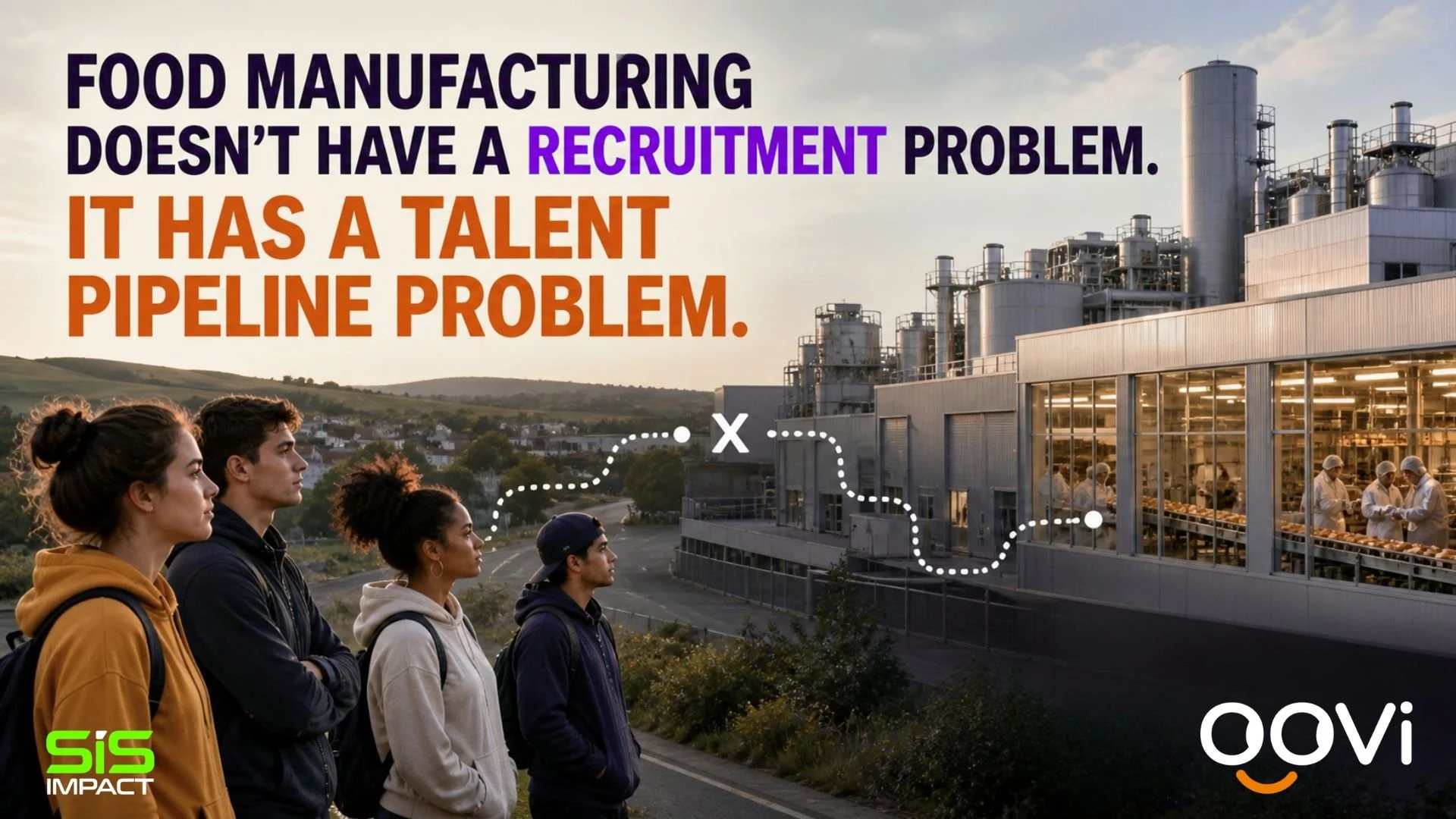
Food Manufacturing Doesn’t Have a Recruitment Problem. It Has a Talent Pipeline Problem.
May 5, 2026 by Jonathan Clitheroe
Food and drink manufacturing is facing a serious talent problem. Not a short-term hiring issue, and not something that can be fixed by improving job adverts or tweaking recruitment processes. This is a structural, local, system-wide challenge that has been building for years.
Vacancy rates in the sector are now sitting at around 5%, more than double many other areas of manufacturing, and are rising at a time when most other sectors are seeing vacancies fall. That tells us something important. This isn’t a macro labour issue. It’s something specific to how this sector attracts and develops talent.
Most talent solutions are built on a simple assumption that people either want the job but don’t know it exists, or that there are plenty of applicants and the challenge is selecting the right ones. That’s why the market is full of employer branding tools, recruitment marketing platforms and AI-driven hiring systems. These solutions work when there is already demand, when people are actively looking and applying.
In food manufacturing, that assumption breaks down. People aren’t applying, and more importantly, they’re not even thinking about applying. The issue isn’t awareness alone. It’s much deeper.
The Sector has a visibility problem
First, many people simply don’t see factories as employers. They are physically present in communities, often large and prominent, but effectively invisible when it comes to career choices.
Second, where there is awareness, there is often a negative perception. Manufacturing roles are commonly associated with low pay, inflexible shifts and physically demanding work. That perception, whether fully accurate or not, shapes behaviour.
Awareness is not enough
Third, and most importantly, people don’t see these roles as being “for them.” They don’t believe they have the skills, the experience or the confidence to succeed in that environment.
This is where the problem becomes distinctly different from most other sectors. It is not simply about telling people that jobs exist. It is about helping people see themselves in the sector and believe that there could be a future for them there.
Every site has its own talent ecosystem
Food manufacturing operates in a hyper-local labour market. People don’t travel long distances to work in factories. Shift patterns, transport limitations and cost of travel mean that most workers come from within a relatively small geographic radius.
That means every site has its own talent ecosystem. A company like Compleat doesn’t have a single talent challenge; it has multiple, each shaped by the characteristics of the local community around each site.
Talent supply in these environments is driven by factors that sit well beyond the control of traditional recruitment teams. It is shaped by local schools and careers advice, further education provision, jobcentre effectiveness, transport infrastructure, family expectations and community attitudes towards work.
In many cases, these sites are located in areas that have experienced long-term economic change, where confidence and connection to opportunity have been eroded over time.

You cannot optimise a funnel that does not exist
This is why many existing solutions struggle to make an impact. They are designed to optimise a funnel, to improve conversion, efficiency or candidate experience.
But in this context, there is no funnel to optimise.
The challenge is building the pipeline from scratch.
It is also why scale does not solve the problem. Even large, global food manufacturers are affected. Margins in the sector are tight, cost pressures are high, and workforce instability has a direct impact on performance.
The issue is not a lack of effort or investment. It is that the underlying system is not producing the talent required.
The solution has to be local, relational and connected
Solving this problem requires a different approach.
It requires deep, local understanding and the ability to work across multiple parts of the system. Colleges, employers, jobcentres and local authorities all play a role, but they operate with different priorities.
Aligning those priorities is not straightforward, and it does not happen through technology alone.
At the same time, individuals do not change their behaviour because they see a job advert. Applying for a role in a factory often requires a shift in how someone sees themselves, their capabilities, their options and their future.
That shift happens through trust, through relationships and through exposure to real pathways.
Technology does not solve the problem, it scales the solution
This is where we believe technology has a role, but not the one most people assume. Technology does not solve this problem. It scales the solution.
The real work is done by people , trusted practitioners, educators and local connectors who can engage individuals and help them see opportunity differently. Technology allows that work to reach further and happen faster.
Why OOVi Talent exists
We built OOVi Talent because this is not a recruitment problem. It is a local talent system problem.
Addressing it means building hyper-local talent communities, connecting individuals to real opportunities and creating clear, credible pathways into work.
It means starting at site level, understanding the specific dynamics of each location and then designing solutions that can scale across regions. Food manufacturing needs talent communities, not just applicants.
Food manufacturing does not need more job adverts. It needs more people choosing to see themselves in the sector.That requires a different kind of approach, one that is rooted in place, built on relationships and designed to change how people engage with opportunity. That is the problem we are trying to solve with OOVi Talent.